Why Your Google Ads Get Clicks but No Enquiries (and How to Fix It)

Last checked: 5 November 2026. Google Ads settings change often, so check the linked Google Ads Help pages before you act.

Short answer: If your Google Ads get clicks but no enquiries, the problem is usually one of four things: the wrong searches are triggering your ads, the wrong people (or places) are seeing them, the landing page doesn’t make it easy to get in touch, or enquiries are happening but your conversion tracking isn’t counting them. Check tracking first, then search terms, then the page.

Why do Google Ads get clicks but no enquiries?

Clicks without enquiries almost always mean a mismatch somewhere between what people searched for, what your ad promised and what your page delivered. A click tells you the ad was interesting enough. An enquiry tells you the searcher, the offer and the page all lined up.

For small businesses in the UK, Spain and the US, the most common causes fall into five groups:

CauseWhat it looks likeWhere to check
Tracking is broken or missingEnquiries arrive by phone, email or WhatsApp but Google Ads shows zero conversionsGoals > Conversions, Google Tag Assistant
Wrong searchesClicks from people looking for jobs, free advice, DIY or a different productSearch terms report
Wrong locationsClicks from outside the area you serveLocation settings and the locations report
Wrong networkSpend going to Display or partner sites rather than Google SearchNetwork settings, channel prioritisation
Weak landing pageHigh clicks, short visits, no calls or formsLanding page experience in Quality Score columns

Is your conversion tracking actually counting enquiries?

Before changing anything else, make sure “no enquiries” really means none. Many small business accounts only track form submissions, so calls, emails and messages never show up, and the campaign looks like it’s failing when it isn’t.

Google’s guide to conversion measurement explains that you choose what counts as valuable, such as a purchase, sign-up or phone call. It also notes three things worth checking:

  • Calls need their own setup. Calls from call assets can be tracked with a Google forwarding number, and Google recommends enabling call reporting and setting a minimum call length so short misdials don’t count.
  • Primary versus secondary matters. Google says that configuring conversion actions correctly as primary (used for bidding) or secondary (observation only) is critical, because Smart Bidding relies on those signals.
  • New tags look inactive at first. An “Unverified” or “Inactive” status is normal for new tags until the first conversion or test event is recorded. For advertisers in the European Economic Area, which includes Spain, Google says Consent Mode must be configured correctly to avoid tracking gaps.

A quick sense check: compare last month’s enquiries in your inbox, phone log and WhatsApp against the conversions Google Ads reports. If the numbers are far apart, fix tracking before you touch the campaigns.

Which searches are triggering your ads?

Open the search terms report. It shows the actual searches that triggered your ads, which is often very different from your keyword list.

Google’s search terms report guide describes a search term as the words a person actually types, and a keyword as the words you add to your ad group. With broad match, a keyword like “flowers” can show your ad for searches about products you don’t sell. Google’s own advice is to add irrelevant search terms as negative keywords.

When you review the report, look for searches that signal the wrong intent:

  • Job seekers (“jobs”, “salary”, “apprenticeship”, “careers”)
  • Free or DIY intent (“free”, “template”, “how to do it yourself”)
  • Competitors or brands you don’t stock
  • Services you don’t offer, or areas you don’t cover
  • Research-only searches that are unlikely to enquire (“what is”, “meaning”, “course”)

One detail that catches people out: according to Google’s negative keywords guide, negative keywords do not match close variants. If you want to exclude both “job” and “jobs”, you need to add both. Google also warns that too many negatives can cut your reach, so add them based on real search terms, not guesswork.

Is AI Max sending your ads to broader searches and different pages?

If your Search campaign uses AI Max, Google may be showing your ads on searches beyond your keyword list and sending clicks to pages you didn’t choose.

Google’s explanation of how AI Max works says that turning on AI Max turns on search term matching, which expands your keywords using broad match and “keywordless technology”. It also switches on text customisation and Final URL expansion. Google’s Final URL expansion guide says Google may replace your final URL with a page it thinks is more relevant and generate matching headlines and descriptions.

That can work well when your site is strong. It can also send paid clicks to a blog post or an “About us” page with no clear way to enquire. Three checks:

  1. Look at the search terms report for AI Max match types and add negatives where intent is wrong.
  2. Check which landing pages are actually receiving clicks.
  3. Use URL exclusions to keep traffic away from pages that don’t convert, or turn Final URL expansion off if you need full control.

Are the right people in the right places seeing your ads?

Check your location settings. By default, Google Ads location targeting reaches people who are in your target area, regularly there, or who have shown interest in it.

Google’s advanced location options guide explains that this default is called “Presence or Interest”. Google’s example is a bakery in Paris whose ads can show to people in Paris and to people elsewhere who have shown interest in Paris bakeries. For a business that only serves people locally, such as a plumber in Leicester or a clinic in Marbella, Google says “Presence” targeting makes sense when you only want to reach people in, or regularly in, your chosen locations.

Google also notes that location targeting is a best effort and isn’t 100% accurate, so check the locations report for clicks from places you don’t serve.

Is your budget going to Display instead of Search?

If your Search campaign has the Google Display Network switched on, some of your budget can be spent on websites and apps rather than search results. Display clicks usually come from people who weren’t actively searching for you.

This setting is changing. According to Google’s Display Expansion guide, from February 2027 Search campaigns with Display Expansion will move automatically to channel prioritisation, and the current spend allocation will go away. Google says you can keep your current setup by setting the Display Network to “Low priority” with a 50% daily budget allocation. If you’d rather keep a small budget on search only, review this setting now rather than in February.

Does your landing page make it easy to enquire?

A landing page has one job: turn the click into a conversation. If people arrive and can’t quickly see that you offer what they searched for, in their area, and how to get in touch, they leave.

Google’s Quality Score guide lists landing page experience as one of three components, alongside expected clickthrough rate and ad relevance. Google describes landing page experience as how relevant and useful your page is to people who click your ad. It also says Quality Score is a diagnostic tool, not an input in the ad auction, so treat a “Below average” landing page rating as a signal to investigate, not a score to chase.

What good looks like for a small business landing page:

  • The headline repeats what the person searched for (“Emergency boiler repair in Leicester”, not “Welcome to our website”).
  • Your phone number, a short form and a messaging option are visible without scrolling on mobile.
  • Prices, starting prices or “what it costs” guidance, where you can give it.
  • Proof close to the call to action: reviews, accreditations or a short case study.
  • Fast loading and no pop-ups that block the page on mobile.

On messaging, Rob Mobsby, Creative Director at Everything Digital, recommends WhatsApp for small businesses because it lets them talk with customers 24/7, and consistent touch points build comfort and trust. For many local service businesses, a WhatsApp button is a lower-effort first step than a form.

If your website itself is the problem, our web build and management team can help.

Are you checking new automatic features?

Google Ads now switches some features on automatically, so review your account settings regularly. Digital marketing agency Two Octobers reported on 3 November 2026 that from 12 October eligible advertisers could have website coupons and deals turned into Google Ads promotion assets automatically unless they opt out. If your site still shows an expired offer, that could appear in your ads and disappoint the people who click.

The safest habit is a short weekly review of recommendations, auto-applied changes and automatically created assets, so nothing goes live that you wouldn’t have chosen yourself.

What do most small businesses get wrong?

The most common mistake is changing everything at once. If you change keywords, landing page, bidding and budget in the same week, you won’t know which change helped.

Other frequent problems:

  • Judging results on clicks or click-through rate instead of enquiries and cost per enquiry
  • Sending every ad to the homepage
  • Relying on broad match without checking search terms
  • Not answering calls or messages quickly, so paid enquiries go cold
  • Stopping a campaign before it has enough data to judge

Checklist: what to check when Google Ads get clicks but no enquiries

  1. Compare real enquiries (calls, forms, emails, WhatsApp) with conversions reported in Google Ads.
  2. Confirm every conversion action is set up, active and correctly marked as primary or secondary.
  3. Set up call tracking and a sensible minimum call length.
  4. In the EEA (including Spain), check Consent Mode is configured correctly.
  5. Review the search terms report and add negative keywords, including plurals and variants.
  6. If you use AI Max, check AI Max search terms and the landing pages receiving clicks; use URL exclusions where needed.
  7. Check location settings (“Presence” versus “Presence or Interest”) and the locations report.
  8. Check whether the Display Network is on in Search campaigns and review channel priorities before February 2027.
  9. Make sure each ad group sends people to a matching page with a clear phone number, form and messaging option on mobile.
  10. Review auto-applied recommendations and automatically created assets, including promotions.
  11. Change one major thing at a time and give it time to gather data.

Frequently asked questions

How many clicks should I get before I expect an enquiry?

There’s no universal number, because it depends on your industry, price and offer. Judge results on cost per enquiry over a few weeks, not on a handful of clicks.

Is a low click-through rate the reason I get no enquiries?

Not usually. A low click-through rate means fewer people click; if you’re getting clicks but no enquiries, look at search terms, tracking and the landing page first.

Should I use broad match keywords?

Broad match can find new searches, but it needs regular search term reviews and good negative keywords. On a small budget, start tightly and widen once tracking shows what converts.

Does Quality Score affect how much I pay?

Google says Quality Score itself is a diagnostic tool and isn’t an input in the ad auction. Its components, including landing page experience, still point to what you can improve.

Should I turn off the Display Network on Search campaigns?

If you want spend to go only to people actively searching, many small businesses keep Search campaigns on search only. From February 2027, Google is moving Display on Search campaigns to channel prioritisation, so review the setting now.

Can AI Max send people to the wrong page?

It can send traffic to a different page on your site if Final URL expansion is on. Google provides URL exclusions, and you can turn Final URL expansion off.

Do I need an agency to fix this?

Not always. The checklist above covers what most business owners can check themselves; an agency helps when tracking is complex or you don’t have time to review the account each week.

Summary

Clicks without enquiries are a signal, not a verdict. Start by making sure tracking counts every real enquiry, then tighten the searches and locations your ads appear for, keep budget on the right network, and make your landing page the easiest possible place to get in touch. Change one thing at a time and judge it on cost per enquiry.

Want a second pair of eyes on your Google Ads?

If you’d like an expert check of your account, our paid media team can review your tracking, search terms, settings and landing pages. Read more about building a paid media strategy, compare our digital packages, or book a free call with Everything Digital.

More Insights

Continue exploring the latest ideas, trends, and expert insights from our team.

So, if your Meta Ads are struggling with high CPMs, limited reach or inconsistent ROAS, the problem may not be your budget. It could be how tightly you are controlling the audience.
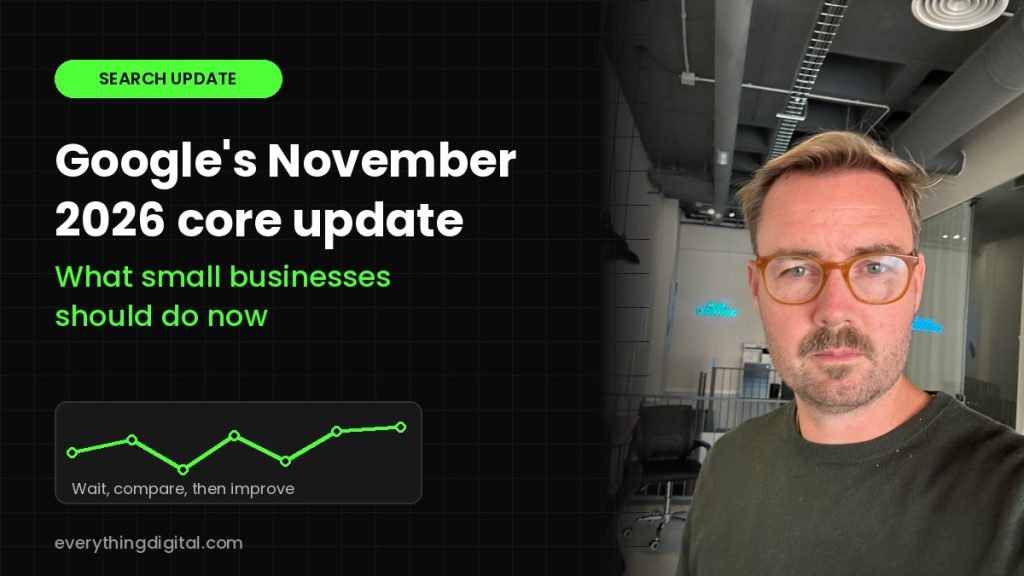
Google's November 2026 core update started on 10 November. What it means for small businesses, when to check Search Console and what to do if rankings drop.
A successful Google Ads strategy isn't just about choosing the right keywords or increasing your budget. It’s about understanding where customers are in the buying process and creating campaigns that guide them from awareness to purchase.
Email marketing remains one of the highest-ROI digital marketing channels. However, results depend on quality, not quantity.

What Our Clients Say

Privacy Policy

Last updated: February 07, 2025

This Privacy Policy describes Our policies and procedures on the collection, use and disclosure of Your information when You use the Service and tells You about Your privacy rights and how the law protects You.

We use Your Personal data to provide and improve the Service. By using the Service, You agree to the collection and use of information in accordance with this Privacy Policy. 

Interpretation and Definitions

Interpretation

The words of which the initial letter is capitalized have meanings defined under the following conditions. The following definitions shall have the same meaning regardless of whether they appear in singular or in plural.

Definitions

For the purposes of this Privacy Policy:

  • Account means a unique account created for You to access our Service or parts of our Service.
  • Affiliate means an entity that controls, is controlled by or is under common control with a party, where “control” means ownership of 50% or more of the shares, equity interest or other securities entitled to vote for election of directors or other managing authority.
  • Company (referred to as either “the Company”, “We”, “Us” or “Our” in this Agreement) refers to Everything Branded Limited, 1 Waterloo Way LE 1 6LP Leicester, United Kingdom.
  • Cookies are small files that are placed on Your computer, mobile device or any other device by a website, containing the details of Your browsing history on that website among its many uses.
  • Country refers to: United Kingdom
  • Device means any device that can access the Service such as a computer, a cellphone or a digital tablet.
  • Personal Data is any information that relates to an identified or identifiable individual.
  • Service refers to the Website.
  • Service Provider means any natural or legal person who processes the data on behalf of the Company. It refers to third-party companies or individuals employed by the Company to facilitate the Service, to provide the Service on behalf of the Company, to perform services related to the Service or to assist the Company in analyzing how the Service is used.
  • Usage Data refers to data collected automatically, either generated by the use of the Service or from the Service infrastructure itself (for example, the duration of a page visit).
  • Website refers to Everything Digital, accessible from https://everythingdigital.com
  • You means the individual accessing or using the Service, or the company, or other legal entity on behalf of which such individual is accessing or using the Service, as applicable.

Collecting and Using Your Personal Data

Types of Data Collected

Personal Data

While using Our Service, We may ask You to provide Us with certain personally identifiable information that can be used to contact or identify You. Personally identifiable information may include, but is not limited to:

  • Email address
  • First name and last name
  • Phone number
  • Usage Data

Usage Data

Usage Data is collected automatically when using the Service.

Usage Data may include information such as Your Device’s Internet Protocol address (e.g. IP address), browser type, browser version, the pages of our Service that You visit, the time and date of Your visit, the time spent on those pages, unique device identifiers and other diagnostic data.

When You access the Service by or through a mobile device, We may collect certain information automatically, including, but not limited to, the type of mobile device You use, Your mobile device unique ID, the IP address of Your mobile device, Your mobile operating system, the type of mobile Internet browser You use, unique device identifiers and other diagnostic data.

We may also collect information that Your browser sends whenever You visit our Service or when You access the Service by or through a mobile device.

Tracking Technologies and Cookies

We use Cookies and similar tracking technologies to track the activity on Our Service and store certain information. Tracking technologies used are beacons, tags, and scripts to collect and track information and to improve and analyze Our Service. The technologies We use may include:

  • Cookies or Browser Cookies. A cookie is a small file placed on Your Device. You can instruct Your browser to refuse all Cookies or to indicate when a Cookie is being sent. However, if You do not accept Cookies, You may not be able to use some parts of our Service. Unless you have adjusted Your browser setting so that it will refuse Cookies, our Service may use Cookies.
  • Web Beacons. Certain sections of our Service and our emails may contain small electronic files known as web beacons (also referred to as clear gifs, pixel tags, and single-pixel gifs) that permit the Company, for example, to count users who have visited those pages or opened an email and for other related website statistics (for example, recording the popularity of a certain section and verifying system and server integrity).

Cookies can be “Persistent” or “Session” Cookies. Persistent Cookies remain on Your personal computer or mobile device when You go offline, while Session Cookies are deleted as soon as You close Your web browser. Learn more about cookies on the Free Privacy Policy website article.

We use both Session and Persistent Cookies for the purposes set out below:

  • Necessary / Essential Cookies

Type: Session Cookies

Administered by: Us

Purpose: These Cookies are essential to provide You with services available through the Website and to enable You to use some of its features. They help to authenticate users and prevent fraudulent use of user accounts. Without these Cookies, the services that You have asked for cannot be provided, and We only use these Cookies to provide You with those services.

  • Cookies Policy / Notice Acceptance Cookies

Type: Persistent Cookies

Administered by: Us

Purpose: These Cookies identify if users have accepted the use of cookies on the Website.

  • Functionality Cookies

Type: Persistent Cookies

Administered by: Us

Purpose: These Cookies allow us to remember choices You make when You use the Website, such as remembering your login details or language preference. The purpose of these Cookies is to provide You with a more personal experience and to avoid You having to re-enter your preferences every time You use the Website.

For more information about the cookies we use and your choices regarding cookies, please visit our Cookies Policy or the Cookies section of our Privacy Policy.

Use of Your Personal Data

The Company may use Personal Data for the following purposes:

  • To provide and maintain our Service, including to monitor the usage of our Service.
  • To manage Your Account: to manage Your registration as a user of the Service. The Personal Data You provide can give You access to different functionalities of the Service that are available to You as a registered user.
  • For the performance of a contract: the development, compliance and undertaking of the purchase contract for the products, items or services You have purchased or of any other contract with Us through the Service.
  • To contact You: To contact You by email, telephone calls, SMS, or other equivalent forms of electronic communication, such as a mobile application’s push notifications regarding updates or informative communications related to the functionalities, products or contracted services, including the security updates, when necessary or reasonable for their implementation.
  • To provide You with news, special offers and general information about other goods, services and events which we offer that are similar to those that you have already purchased or enquired about unless You have opted not to receive such information.
  • To manage Your requests: To attend and manage Your requests to Us.
  • For business transfers: We may use Your information to evaluate or conduct a merger, divestiture, restructuring, reorganization, dissolution, or other sale or transfer of some or all of Our assets, whether as a going concern or as part of bankruptcy, liquidation, or similar proceeding, in which Personal Data held by Us about our Service users is among the assets transferred.
  • For other purposes: We may use Your information for other purposes, such as data analysis, identifying usage trends, determining the effectiveness of our promotional campaigns and to evaluate and improve our Service, products, services, marketing and your experience.

We may share Your personal information in the following situations:

  • With Service Providers: We may share Your personal information with Service Providers to monitor and analyze the use of our Service, to contact You.
  • For business transfers: We may share or transfer Your personal information in connection with, or during negotiations of, any merger, sale of Company assets, financing, or acquisition of all or a portion of Our business to another company.
  • With Affiliates: We may share Your information with Our affiliates, in which case we will require those affiliates to honor this Privacy Policy. Affiliates include Our parent company and any other subsidiaries, joint venture partners or other companies that We control or that are under common control with Us.
  • With business partners: We may share Your information with Our business partners to offer You certain products, services or promotions.
  • With other users: when You share personal information or otherwise interact in the public areas with other users, such information may be viewed by all users and may be publicly distributed outside.
  • With Your consent: We may disclose Your personal information for any other purpose with Your consent.

Retention of Your Personal Data

The Company will retain Your Personal Data only for as long as is necessary for the purposes set out in this Privacy Policy. We will retain and use Your Personal Data to the extent necessary to comply with our legal obligations (for example, if we are required to retain your data to comply with applicable laws), resolve disputes, and enforce our legal agreements and policies.

The Company will also retain Usage Data for internal analysis purposes. Usage Data is generally retained for a shorter period of time, except when this data is used to strengthen the security or to improve the functionality of Our Service, or We are legally obligated to retain this data for longer time periods.

Transfer of Your Personal Data

Your information, including Personal Data, is processed at the Company’s operating offices and in any other places where the parties involved in the processing are located. It means that this information may be transferred to — and maintained on — computers located outside of Your state, province, country or other governmental jurisdiction where the data protection laws may differ than those from Your jurisdiction.

Your consent to this Privacy Policy followed by Your submission of such information represents Your agreement to that transfer.

The Company will take all steps reasonably necessary to ensure that Your data is treated securely and in accordance with this Privacy Policy and no transfer of Your Personal Data will take place to an organization or a country unless there are adequate controls in place including the security of Your data and other personal information.

Delete Your Personal Data

You have the right to delete or request that We assist in deleting the Personal Data that We have collected about You.

Our Service may give You the ability to delete certain information about You from within the Service.

You may update, amend, or delete Your information at any time by signing in to Your Account, if you have one, and visiting the account settings section that allows you to manage Your personal information. You may also contact Us to request access to, correct, or delete any personal information that You have provided to Us.

Please note, however, that We may need to retain certain information when we have a legal obligation or lawful basis to do so.

Disclosure of Your Personal Data

Business Transactions

If the Company is involved in a merger, acquisition or asset sale, Your Personal Data may be transferred. We will provide notice before Your Personal Data is transferred and becomes subject to a different Privacy Policy.

Law enforcement

Under certain circumstances, the Company may be required to disclose Your Personal Data if required to do so by law or in response to valid requests by public authorities (e.g. a court or a government agency).

Other legal requirements

The Company may disclose Your Personal Data in the good faith belief that such action is necessary to:

  • Comply with a legal obligation
  • Protect and defend the rights or property of the Company
  • Prevent or investigate possible wrongdoing in connection with the Service
  • Protect the personal safety of Users of the Service or the public
  • Protect against legal liability

Security of Your Personal Data

The security of Your Personal Data is important to Us, but remember that no method of transmission over the Internet, or method of electronic storage is 100% secure. While We strive to use commercially acceptable means to protect Your Personal Data, We cannot guarantee its absolute security.

Children’s Privacy

Our Service does not address anyone under the age of 13. We do not knowingly collect personally identifiable information from anyone under the age of 13. If You are a parent or guardian and You are aware that Your child has provided Us with Personal Data, please contact Us. If We become aware that We have collected Personal Data from anyone under the age of 13 without verification of parental consent, We take steps to remove that information from Our servers.

If We need to rely on consent as a legal basis for processing Your information and Your country requires consent from a parent, We may require Your parent’s consent before We collect and use that information.

Links to Other Websites

Our Service may contain links to other websites that are not operated by Us. If You click on a third party link, You will be directed to that third party’s site. We strongly advise You to review the Privacy Policy of every site You visit.

We have no control over and assume no responsibility for the content, privacy policies or practices of any third party sites or services.

Changes to this Privacy Policy

We may update Our Privacy Policy from time to time. We will notify You of any changes by posting the new Privacy Policy on this page.

We will let You know via email and/or a prominent notice on Our Service, prior to the change becoming effective and update the “Last updated” date at the top of this Privacy Policy.

You are advised to review this Privacy Policy periodically for any changes. Changes to this Privacy Policy are effective when they are posted on this page.

Contact Us

If you have any questions about this Privacy Policy, You can contact us:

  • By email: hello@everythingdigital.com


Terms and Conditions


  1. Scope of Services

The Agency agrees to provide digital marketing services to the Client. The specific solutions and deliverables will be outlined in “Scope of Solutions and Dates” once mutually agreed upon. These may include, but are not limited to:


  1. Term and Termination
    • Term: The term of this Agreement begins on the date it is signed and will continue until terminated in accordance with this Agreement.
    • Termination: Either party may terminate this Agreement with [30 days] written notice. Upon termination, any services performed up to the date of termination will be billed accordingly.


  1. Payment Terms
    • Fees: Client agrees to pay Agency 14 days from commencement of agreement. All fees will be due on the agreed schedule monthly basis. All invoices will be sent at the start of each month.
    • Late Payments: Any overdue payments will incur a late fee of [5%] per month on the unpaid balance.
    • Expenses: The Client will reimburse the Agency for any approved expenses incurred on behalf of the Client, if applicable.


  1. Confidentiality and Ownership
    • Confidentiality: Both parties agree to keep confidential any proprietary information shared in the course of this Agreement.
    • Ownership of Deliverables: All completed deliverables are owned by the Client upon full payment, unless otherwise agreed.


  1. Performance Standards
    • The Agency will perform all services with reasonable skill and care, consistent with industry standards. The Agency cannot guarantee specific outcomes but will use best practices and a good-faith effort to achieve Client’s goals.


  1. Limitation of Liability
    • In no event will the Agency be liable for any consequential damages resulting from the services provided, including lost profits or business interruptions.


  1. Miscellaneous
    • Amendments: This Agreement can only be amended in writing and signed by both parties.
    • Governing Law: This Agreement shall be governed by the laws of [United Kingdom].
    • Entire Agreement: This document constitutes the entire agreement between the parties and supersedes any prior agreements or understandings.