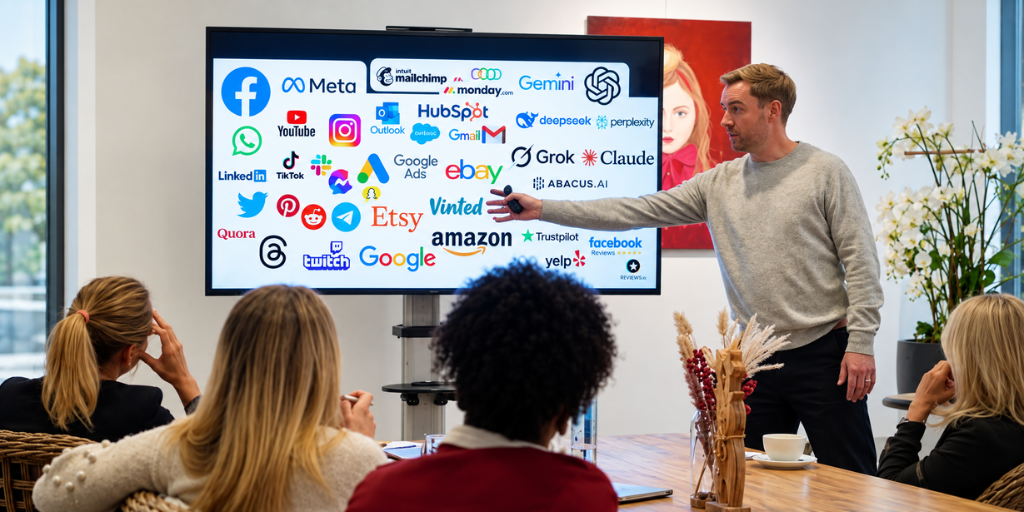
Good creative looks great. Great creative also has a job to do.
It needs to catch someone’s attention, communicate the right message and give them a reason to keep going. Sometimes that means clicking an advert. Sometimes it means remembering a brand, exploring a website, downloading something or getting in touch.
It starts with understanding that creative is not simply about making something look good. It is about connecting the audience, the message, the channel and the action you want someone to take.
What is creative marketing?
Creative marketing is the use of visual design, messaging and campaign ideas to communicate a brand or offer in a way that gets attention and encourages action.
That might mean developing a brand identity, creating a campaign, designing social content, producing paid-ad assets or turning a complex service into a clearer website experience. The format changes depending on the situation, but the purpose remains the same: make the right message easier to notice, understand and act on.
Why does creative matter to marketing?
People make decisions quickly. Before someone reads your copy, explores your website or considers your offer, they first need to notice it.
That is where creative creates an opening.
But attention alone is not enough. An advert can look impressive and still fail if the message is unclear. A website can look polished but leave visitors wondering what the business actually does. Good creative brings those pieces together, making the message clear enough to understand and the next step easy to recognise.
In other words, creative should not just get attention. It should give that attention somewhere to go.
What should creative be based on?
The first question should not be, “What should it look like?”
It should be, “Who are we trying to reach, what do they need to hear and what do we want them to do?”
A paid advert might need to communicate a proposition in seconds. A landing page has more space to explain and persuade. A sales presentation may need to make a complex service easier to understand, while social templates need to work repeatedly without losing the brand identity.
The creative should follow the purpose. Once the audience, message and objective are clear, the visual direction becomes much easier to define.
Should creative be consistent across different channels?
Yes, but consistency does not mean making every asset look identical.
A strong creative idea should still feel connected when someone encounters it on a website, social media, an advert, an email or printed material. The format can change to suit the channel while the core idea, message and visual direction remain recognisable.
This becomes particularly important for campaigns. Rather than creating a completely different idea for every platform, one strong campaign concept can be adapted across multiple touchpoints. The result is a more joined-up experience — and a campaign that can work harder across the customer journey.
What creative assets does a business actually need?
There is no universal list because every business has different audiences, challenges and goals.
One business might need a new visual identity or brand refresh. Another might need campaign concepts, paid-ad creative and social templates. A growing sales team might need brochures and presentations, while a website project could require landing-page design and supporting graphics.
For businesses producing creative regularly, guidelines and template systems can also make a big difference. They give teams a clear framework to work from, helping maintain consistency without needing to reinvent the brand for every new piece of content.
The question is not really “How many assets do we need?”
It is “Which creative will help us achieve what we are trying to achieve?”
How does creative support conversion?
Creative supports conversion by helping people move through the customer journey.
A campaign might create awareness. An advert can introduce an offer. A landing page can explain it in more detail. A case study can provide evidence, while a clear call to action gives someone an obvious next step.
Each piece has a role, and those roles work better when they are connected.
This is why creative should not sit separately from the rest of your marketing. When brand, web, paid, social and content work from the same strategy, creative can support the journey from that first moment of attention through to consideration and action.
What is the creative process?
Good creative starts with clarity.
At Everything Digital, the process begins by understanding the business goal, audience, offer, channel and existing brand. That creates the foundation for the creative brief, where the core message, campaign purpose and required formats are defined.
From there, ideas and visual directions are developed before the chosen concept is brought to life. Once created, the work can be adapted across web, paid, social, email, print and other channels.
And it does not necessarily stop there.
Campaign performance and feedback can reveal what is working, what could be clearer and where future creative can improve. That makes creative an ongoing part of marketing rather than simply a one-off design task.
Does good creative need to be complicated?
Not at all.
In fact, complex propositions often benefit from simpler creative.
A business might offer technical services, operate across several markets or have multiple products that are difficult to explain quickly. The role of creative is to make that complexity easier to understand, not add another layer to it.
The strongest creative is often the work that makes something complicated feel simple.
That might be a clear visual hierarchy, a straightforward campaign idea, a more intuitive landing page or a set of templates that make a brand easier to recognise.
Get attention. Make the message clear. Build trust. Give people a reason to act.
That is what turns creative from an aesthetic exercise into a useful part of your marketing strategy.